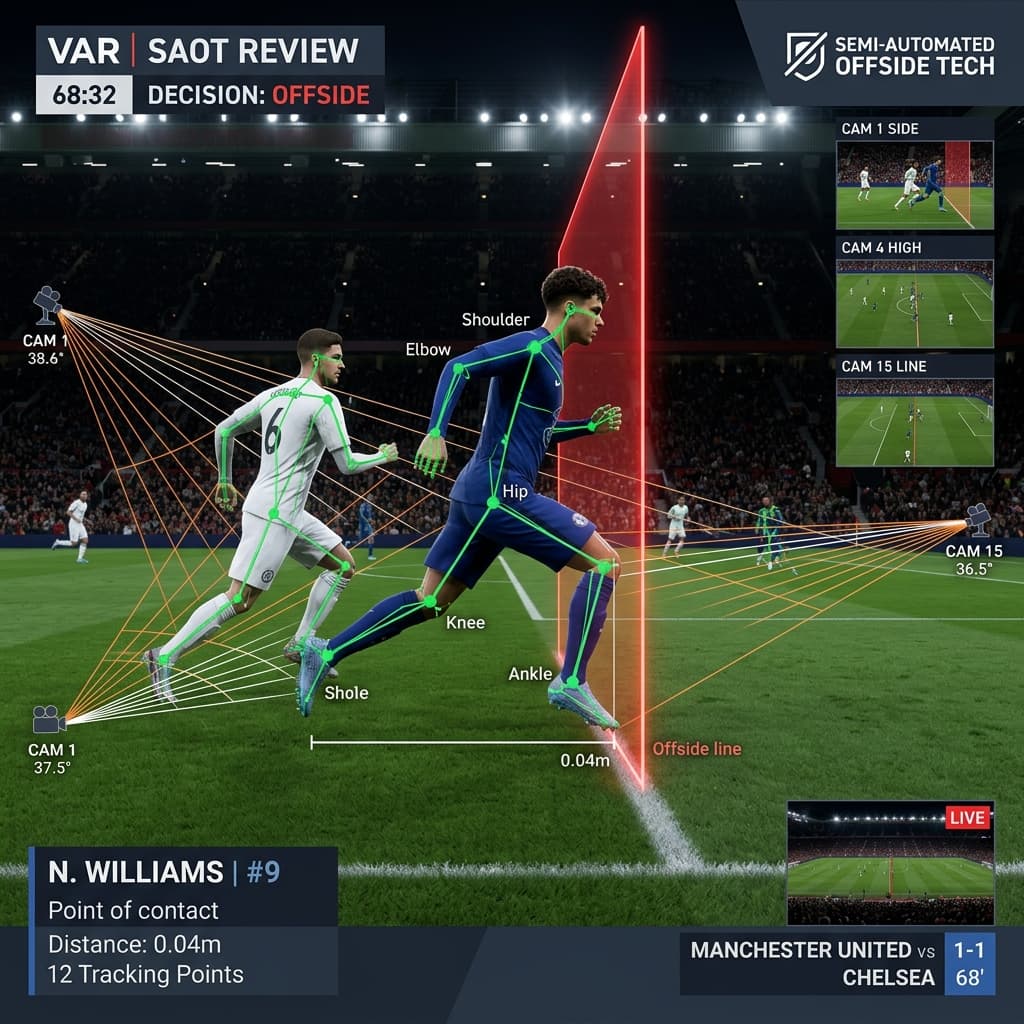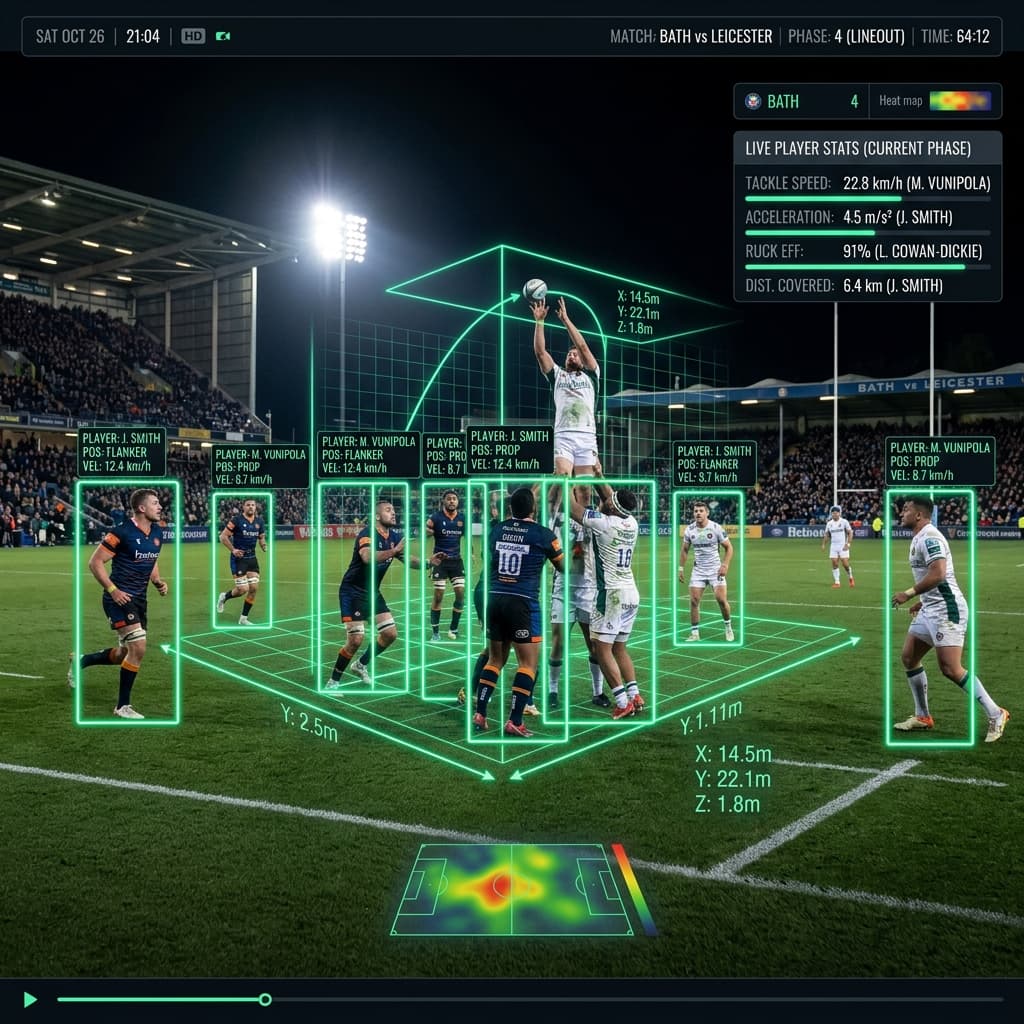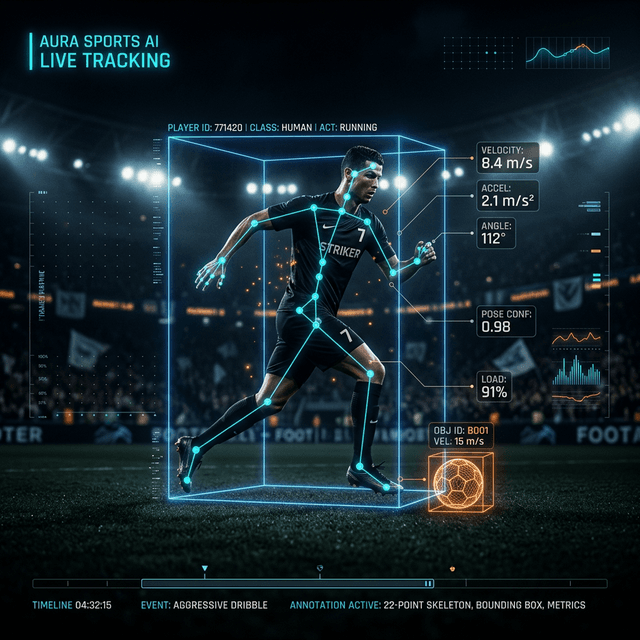
Sports computer vision companies build the technology that turns match footage into structured data — player tracking, ball detection, event recognition, tactical analytics, broadcast overlays and officiating tools. There are dozens of companies operating in this space, but they do very different things. Some build the cameras. Some build the models. Some supply the training data the models require.
This guide explains who's in the ecosystem, what each type of company does, and how to evaluate a data partner if you're building sports CV models yourself.
What is a sports computer vision company?
A sports computer vision company uses AI to interpret sports footage — detecting and tracking players, the ball and officials, classifying game events, and generating structured data for analytics, coaching, broadcast and officiating. Some companies build end-to-end tracking products. Others specialise in one layer of the pipeline: cameras, models, annotation, or data feeds.
The ecosystem is not a single type of company. Understanding the landscape matters before you evaluate any vendor.
The sports computer vision company landscape
Sports computer vision sits across five distinct company types. Most vendors operate in one or two of these layers, not all five.
| Company type | What they build | Who buys from them |
|---|---|---|
| Tracking technology | Camera systems, automated multi-angle rigs, real-time tracking hardware | Leagues, stadiums, broadcasters |
| AI model builders | Player tracking models, ball detection, pose estimation, event recognition | Sports tech platforms, clubs, AI labs |
| Sports data providers | Finished statistics, event feeds, match data APIs | Betting operators, fantasy platforms, media |
| Annotation and training data | Labeled video datasets, ground-truth data for model training | AI model builders, research labs, tech companies |
| Analytics platforms | Coaching dashboards, scouting tools, performance systems | Professional clubs, national associations |
Most sports computer vision companies that build AI models need annotation and training data from a specialist partner — they do not annotate their own footage at scale. That is where a managed data partner fits in.
Who are the main sports computer vision companies?
The market splits into established sports data and tracking companies, newer AI-native platforms, and specialist data partners.
Tracking and data technology
Hawk-Eye Innovations (owned by Sony) builds the camera systems and tracking technology behind ball-tracking in cricket, tennis and football. Their systems power DRS in cricket, Hawk-Eye line calls in tennis and goal-line technology in football. They sell to leagues and governing bodies.
Genius Sports provides real-time sports data, broadcast technology and official data collection across multiple sports leagues. They hold exclusive data rights for the NFL, NCAA and several major football leagues.
Stats Perform (formerly Opta) provides player and event data, AI-powered analytics and performance statistics across football, cricket, basketball and American football. Their tracking data underpins many commercial analytics products.
Second Spectrum (owned by Deltatre) provides player tracking and coaching analytics primarily in basketball (official NBA tracking provider) and football. Their models produce optical tracking data consumed by clubs and broadcasters.
Sportlogiq specialises in computer vision analytics for ice hockey and football, using automated optical tracking to produce detailed performance and tactical data.
Tracab (ChyronHego) provides optical tracking systems for football stadiums across Europe, producing player position and ball data used by clubs and broadcasters.
AI-native sports technology
Veo Technologies automates football match recording at grassroots level using a fixed camera with AI-powered panning and zooming. Their product is aimed at amateur clubs.
Metrica Sports builds performance analysis tools and tracking data workflows for professional football clubs, including automated event detection.
Spiideo provides automated recording and video analysis for team sports, targeting professional and semi-professional clubs across football, basketball and volleyball.
Annotation and training data partners
Train Matricx provides managed sports data annotation and AI training datasets for computer vision teams. The focus is on sport-specific ground-truth data — player tracking, ball tracking, skeletal keypoints, event logging and dataset QA. Train Matricx works as the data layer for AI model builders, research labs and sports tech companies that need expert-verified training data matched to their model architecture.
Why sports CV model builders need a separate data partner
The tracking technology companies and analytics platforms listed above all have a shared dependency: AI models that work reliably require large volumes of consistent, expert-labeled training data.
Building and maintaining that annotation function in-house is costly and difficult to scale. The work is:
- Sport-specific: generic annotators cannot accurately label events, player IDs, skeletal keypoints and ball contacts without understanding the sport
- Volume-intensive: a single football season across one league may require millions of labeled frames
- Quality-sensitive: one inconsistent annotator corrupts an entire batch of training data
This is why most sports computer vision companies use external data partners for annotation and ground-truth labeling rather than running annotation operations internally.
How to evaluate a sports computer vision data partner
If you are building sports CV models and evaluating annotation partners, these six criteria separate reliable partners from generic labeling services.
1. Sport-specific domain expertise
Ask whether annotators actually understand the sport. Event logging, player re-identification and tactical context all require interpreters who can distinguish a tactical foul from an accidental collision, or a cricket edge from a pad impact. Verify this by sending a hard clip and reviewing the labeled output before committing to any volume.
2. Schema design capability
A data partner should be able to define the annotation schema before production starts — object classes, event taxonomy, keypoint rules, occlusion handling, player ID continuity and delivery format. If the partner uses a fixed schema that doesn't match your model architecture, the data is useless regardless of label accuracy.
3. Temporal consistency
Sports models require labels across sequences, not just individual frames. Player identity must remain consistent through occlusions, camera cuts and crowded scenes. Ask specifically how the partner handles identity handoff after occlusion and how they verify continuity at the sequence level, not just the frame level.
4. QA with domain checks
A frame can be visually labeled correctly but tactically wrong. A standard QA process that only checks box placement will miss sports-logic errors — wrong event labels, swapped player IDs, incorrect keypoint placement relative to biomechanical continuity. Your partner's QA process should include domain reviewers who understand the sport.
5. Pilot before production
Any serious data partner should offer a pilot dataset — a labeled sample clip you can evaluate against your own QA process before committing to full scale. This is the only reliable way to verify actual output quality rather than relying on claimed accuracy rates.
6. Security and data ownership
Sports footage often contains proprietary match video, unreleased broadcast assets and sensitive player performance data. Verify who has access to raw footage, how transfer and storage are handled, and whether deliverables remain your property.
Buyer checklist
Before selecting a sports computer vision data partner:
- Can the vendor explain the annotation schema for your sport before work starts?
- Have annotators labeled footage in your specific sport before?
- Can they maintain player ID continuity across occlusion and camera cuts?
- Do they offer a paid or free pilot clip for quality evaluation?
- Is the QA process domain-verified, not just visual?
- Can they deliver in your required format (COCO, YOLO, JSON, CSV)?
- Can they scale volume without changing label interpretation?
- Do they have clear data access, security and ownership terms?
Frequently asked questions
What are sports computer vision companies? Sports computer vision companies use AI to interpret sports footage — tracking players and the ball, classifying game events, and converting video into structured data. The market includes tracking hardware providers, AI model builders, analytics platforms and annotation data partners. Each type operates at a different layer of the sports AI stack.
What is the difference between a sports data provider and a sports computer vision company? A sports data provider delivers finished statistics and event feeds — scores, player stats, match timelines. A sports computer vision company builds AI models that generate those insights directly from video footage. The distinction matters when you are evaluating whether a vendor produces data or sells the tools to produce it.
Why do sports computer vision companies need specialized training data? Sports footage is harder to label than standard video. It includes fast motion, player occlusion, similar-looking jerseys, camera cuts and sport-specific rule context. Generic annotation services produce inconsistent labels for these scenarios because the annotators don't understand the sport. Specialised training data requires annotators who can interpret events correctly within the rules and movement patterns of the sport.
What does an annotation data partner do for sports AI? An annotation data partner labels sports video footage with bounding boxes, player IDs, skeletal keypoints, ball positions and event classifications — the structured ground truth that AI models learn from. They are distinct from tracking technology companies; they supply the training data those companies' models require.
How much training data does a sports computer vision model need? It depends on the model objective and sport. A player detection model for football may require thousands of labeled frames across varied match conditions. A full player tracking model maintaining identity across a 90-minute match at 25 fps requires annotation across 135,000 frames per match. Production models for professional sports products are typically trained on data from hundreds of matches.
What sports can computer vision be applied to? Computer vision has been deployed across football, basketball, cricket, tennis, golf, ice hockey, American football, rugby, volleyball and more. Each sport requires its own annotation schema because events, camera setups and object types differ significantly between sports.
How do I verify the quality of a sports annotation partner? Request a pilot annotation on a representative clip — ideally including difficult scenarios like occlusion, camera cuts and high-speed ball motion. Evaluate the output against your own ground truth or with a domain expert review. Claimed accuracy percentages from vendors are not reliable substitutes for reviewing actual labeled output.
What format should sports computer vision training data be delivered in? Common delivery formats include COCO JSON (for detection and segmentation), YOLO (for object detection), CSV or JSON (for event logs and tracking sequences) and custom formats for proprietary pipelines. The format should be agreed and tested with a sample dataset before full-scale production begins.
Is Train Matricx a software platform or a managed service? Train Matricx is a managed annotation service, not a software platform. The company provides trained human annotators, sport-specific taxonomy design, QA and validated dataset delivery. This is distinct from annotation platforms like CVAT or Labelbox, which provide the software workspace but not the annotator workforce.
The takeaway
The sports computer vision market is not a single category. Tracking hardware companies, model builders, data providers and annotation partners all operate at different layers of the stack. Knowing which layer you need a partner in determines which companies are relevant to evaluate.
If you are building sports CV models and need expert-verified training data — player tracking, ball tracking, event logging, skeletal keypoints or dataset QA — see how Train Matricx works or review client results in our case studies. We annotate a free pilot clip so you can evaluate quality before committing to any volume.
Written by
Train Matricx Team